Your Back Is Telling You More Than You Think: What Shiatsu Can Teach You About Your Body

I think most of us, when we think about our back, think about bones and muscles. Perhaps a slipped disc, a stiff lower back, a trapped nerve or that familiar knot between your shoulder blades.
We don't necessarily think about our nervous system, our organs, our circulation, our emotions or even the fluids moving around our body.
Your back is so much more than the thing that holds you upright.
In Chinese medicine, the back gives us a fascinating window into what is happening throughout the body, and this is one of the reasons I have such enormous respect for it.
Find out in this blog what shiatsu can teach you about your body!
My back started my journey into Shiatsu
My first step into the world of energetic therapies actually came because of what was happening around my bladder and nervous system. I was about 22 and had this awful feeling that I constantly needed to wee, even though I didn't actually need to go. One evening it became so bad that I went to the loo sixteen times with that same horrible feeling.
If you've ever experienced that sort of urinary urgency, you'll know exactly what I mean. I eventually went to see an osteopath and, after one session, that nerve sensation disappeared. That was it for me; I was invested.
I didn't yet understand what had happened, but I knew that something had changed in my body without anyone giving me a painkiller or doing anything invasive. The treatment had somehow influenced the messages my nervous system was sending me. That was the beginning.
The mind and emotional side of it came along much later, but from that point onwards I became fascinated by what our bodies are capable of doing and how much information they are constantly sending us. About a decade later I discovered Shiatsu, and when I began training, I started to understand the back in a completely different way.
Your back can tell me a lot about you
In Shiatsu we work with the meridian system, and one of the main pathways running down the back is the Bladder meridian. It's a slightly unfortunate name because it really doesn't sound particularly exciting but this channel is much more interesting than its name suggests.
Alongside the spine are what are known as the Back Shu or Yu points, which in Chinese medicine are associated with the different organs and systems of the body. These points are used as part of a traditional energetic assessment, giving the practitioner another way of looking at the overall balance of the person rather than simply asking, "Where does it hurt?"
When I'm working along someone's back, I'm noticing what I can feel and in Chinese medicine terms this is an array:
Tension fullness emptiness stagnation hesitancy resistance hot cold damp sensitive distrust or wanting… and of course pain.
There’s a whole colourful vocabulary that develops between a Shiatsu practitioner and their client; and everyone's body is different. That's important.
I'm not looking at someone's back and thinking, "Ah, that means they definitely have a problem with their stomach." Instead, I'm building up a picture of what their body is communicating and considering it alongside everything else they've told me.
That is one of the things I love about Shiatsu - we look for patterns.
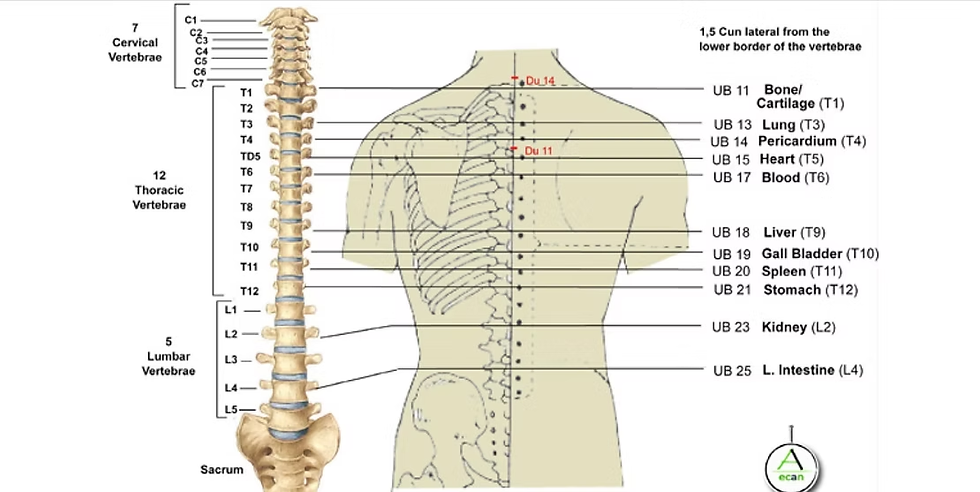
The spine and the nervous system
Your spinal cord is part of your central nervous system, carrying information between your brain and the rest of your body. It's an extraordinary communication system that we take completely for granted when it's working well. Think about everything your brain and body are communicating about throughout the day:
Movement
Temperature
Pain
Touch
Balance
Digestion
Breathing
Your organs are constantly working away in the background while your brain is busy thinking about what you're having for dinner! And then there is everything you can't consciously feel happening; the messages travelling backwards and forwards, helping your body respond to what is happening around you. It isn't simply structural; it’s part of an enormous communication network.
And then there are the fluids...
Here's something I bet you don't immediately think about when you think about your back; fluids.
Cerebrospinal fluid, blood, lymph and EZ water (gel like and lubricates the fascia and is fed by electrolytes) keeping your tissues nourished and functioning properly.
Chinese medicine has always placed enormous importance on the movement of fluids throughout the body placing importance of movement, circulation and flexibility to keep the body flowing and free from becoming stagnant.
When we become stiff, sedentary, stressed and dehydrated, we can certainly feel it physically. Muscles become tighter, movement becomes less comfortable and aches and pains can begin to creep in. I often describe a healthy body as needing to be juicy! And this is where fascia has become particularly interesting to me.

Your back is more than muscles and bones
Fascia is the connective tissue that surrounds muscles, organs, nerves, blood vessels and other structures throughout the body. For a long time fascia was largely overlooked in Western medicine; now we know it is a highly complex and richly innervated tissue communication network, and the traditional Chinese meridian system has long been understood as running through the body's connective tissue.
I find that really interesting because it gives us another way of understanding why the body can feel so interconnected, as well as offering some scientific insight into how Shiatsu and Traditional Chinese Medicine may work.
When we are stressed, our nervous system can influence muscle tension and how we hold ourselves. If that tension becomes our normal state, movement can become restricted and the body can start to feel less fluid.
This is where Shiatsu can benefit you!
I'm not simply looking for the muscle that hurts and trying to make it relax; I'm listening to the whole body. Through sustained pressure, gentle stretches and working along the meridians, we can encourage areas of tension to soften and movement to become easier. The nervous system gets some time away from the constant demands of everyday life too. With regular sessions, your body and nervous system can begin to learn how to release and relax more quickly; we're showing you that there is another way to live in your body.
How powerful is that?
Perhaps that's one of the reasons people often leave a Shiatsu treatment feeling as though their whole body has taken a deep breath.
What does your back have to do with your emotions?
Everything it can hold so many points of emotional tension that it reads like a book. It’s not that every back problem is caused by an emotion; however, an underlying continual emotional state for example worry can cause a weakness that can then lead to a physical injury. In these cases, you should seek medical assessment.
This is where the Chinese medicine perspective reigns as it has been looking at the relationship between emotions, organs and physical symptoms for thousands of years. Modern research has also found associations between perceived stress, life stressors and the development of chronic musculoskeletal pain.
Chinese medicine has been looking at these relationships for millennia.
When I look at a lower back, I'm not just thinking about the muscles.
In traditional Chinese medicine, the Kidney system is associated with the lower back and with your constitutional energy. Fear and prolonged stress are also traditionally associated with the Kidney system; in Chinese medicine, this may be reflected as a weakness or vulnerability in the lower back and a tendency towards continual aching.
Our language often gives us clues about how closely we experience emotions and the body, even if we don't consciously think about the connection; for example:
Have you described someone as being a pain in the neck? Or felt as though you were carrying the weight of the world on your shoulders? Emotions tie in with pains even if you haven’t realised it yet.
The Jitsu is shouting, but the Kyo is whispering
There is a lovely concept in Shiatsu - Kyo and Jitsu.
Jitsu is the part that is shouting - It's the pain that has finally become impossible to ignore. It's the shoulder that won't move properly, the back that hurts every time you get out of the car or the neck that has become so tight you can't turn your head comfortably. That's what gets you into my treatment room.
But then there is Kyo; the quieter part.
The underlying weakness or imbalance that may have been developing for much longer This is why I don't simply want to treat the bit that hurts. I want to understand what else is happening with you. How is your sleep? Your stress levels? Any emotional upheavals? Has movement changed? Have you had an accident or an operation?
The answer may be a combination of all of these things.

I learnt this from one very painful back
When I was training, I had a friend with terrible back pain. She kept going to the osteopath because of the pain, but it wasn't resolving. Eventually it became clear that something else needed investigating and she was diagnosed with a stomach ulcer. This made me realise how easy it is to assume that the place that hurts isn’t necessarily the place where the problem begins. Sometimes it is … but sometimes it isn't.
And this is why I believe good bodywork should listen rather than simply attack the painful area.
Please don't pummel your back into submission!
I have to say this because I've made the mistake myself in my 20s.
Before discovering Shiatsu, I tried deep tissue massage for a persistent shoulder problem. I thought that because it hurt, perhaps I needed something stronger; surely the deeper the pressure, the better the result? It wasn't and it made things worse.
That experience has stayed with me because it taught me something that I now see regularly in my own practice; sometimes the body doesn't need more force, it needs more listening.
There are times when deep pressure is exactly what someone needs, but there are also times when the body is already working incredibly hard to protect itself. If the nervous system is on high alert and the muscles and fascia are already tense, adding more pressure isn't necessarily going to make things better.
Sometimes the body wants pressure; sometimes it wants movement. Nearly all the time, though, your body is asking for support; to simply listen to what it is asking for without forcing change where it isn't ready to receive it.
This is one of the things I love about Shiatsu. I'm constantly assessing through my hands and responding to what the body is giving back. The treatment isn't something I impose on you; it's a conversation between your body and my hands.
I had an American client once who came for a treatment and, at the end, told me: "I really didn't do anything."
I've gotten used to those insults now!
She went home and, the following day, contacted me to apologise. She'd initially wondered what the point of the treatment had been, but then realised she'd experienced an enormous emotional release and that her back felt better than it had done for years. She'd been having weekly chiropractic appointments before coming to me.
What had I done?
I felt her body was stressed and rather than trying to force it to release, I'd given it the space and support to soften. I hadn't tried to pummel the pain out of her or force her body into doing something it wasn't ready to do. I'd listened to what was there.
And sometimes that is enough; to allow the body to start doing what it already knows how to do.
Are you disconnected from your back?
There is absolutely no judgement in that question because I was exactly the same; most of us are.
We spend so much time in our heads that we forget we even have a body until it starts hurting. We sit for hours, stop moving as much as we used to, carry tension without noticing it and then wonder why our back suddenly decides it has had enough. Then comes the day you bend to pick up a heavy box, twist slightly and suddenly your back 'goes'; but often the problem hasn't appeared that morning, it's been quietly building for some time. If you’re lucky and it’s muscular then Shiatsu (or another bodywork) can relieve it but if it becomes a point of weakness thereafter then investigating an emotional link is beneficial.
However, if the pain is inflamed and acute – seek medical advice as it could be something physically serious.
I think one of the most important things we can do for our backs is simply keep them moving. We don't have to turn ourselves into gym bunnies or spend hours stretching; our bodies were designed to move, twist, bend and change position.
This is one of the reasons I love Qi Gong. The gentle flowing movements encourage the spine to move without forcing it and there is something about combining movement with breath that makes you much more aware of what is happening inside your body.
Strength and stability are important too, particularly around the core and pelvis, but I think we sometimes forget that movement doesn't have to be complicated to be beneficial.

Then there is hydration; but I think it's worth thinking beyond simply drinking endless glasses of plain water. Fluids from food, along with water and the minerals your body needs, all play a part in keeping your tissues hydrated and functioning well. As with so many things, it's about balance; hydrate wisely!
When I think about fascia and the importance of keeping the body's tissues supple and able to glide, it makes complete sense to me that our bodies need enough fluid to function well. In Chinese medicine we have always paid attention to the body's fluids and the importance of keeping things moving.
Perhaps the biggest thing, though, is not waiting until your body is screaming before you listen.
Your back has probably been giving you little messages for quite some time before it becomes painful enough to stop you in your tracks.
A little stiffness when you get out of the car. Your shoulder that has gradually become tighter. And a low level but important one - The feeling that you just can't get comfortable.
Pushing on through pain only magnifies it in time but if you listen when your body grumbles, you’re paying attention to your body asking for your help and that is powerful.

Your back deserves some TLC
Your back is an extraordinary piece of your body. It keeps you upright, allows you to move in all the different ways that you take completely for granted and protects your spinal cord, while being connected to an enormous network of muscles, fascia, nerves and other tissues.
From your back I can read your breathe which of your organs are sensitive where you’d like me to work and whether your body trusts the treatment as I begin. The spine also holds a fair amount of trauma; old trauma and helping the spine to let go of and for your breathing to regulate is a powerful transformation to undergo.
Your physical health doesn't sit separately from your emotional health. Your nervous system doesn't know that you've decided today is going to be a stressful day; it simply responds to what is happening. Your muscles don't necessarily know whether the tension they're holding is because you've been sitting awkwardly at your desk or because you're worrying about something that happened yesterday.
The body simply responds.
For me, this is why looking after your back is about much more than treating it when it hurts.
Perhaps it's about developing a relationship with your body so that you notice the little things before they become big things.
But for those everyday aches, stiffness and tension that creep into life, perhaps the first step is simply to become curious.
What Shiatsu Can Teach You About Your Body
What is your back telling you:
Sleeping badly? Carrying more stress? Doing less movement than usual?
A Shiatsu treatment is the opportunity to relax deeply and tune into your body again.
You may arrive because your back hurts but my hope is that you may leave wondering why you feel so much better everywhere else too. And that's one of the things I love most about Shiatsu.
You never quite know what your body is going to tell you when you finally give it an hour to speak.
Book a treatment

About Andrea at Shiatsu Bodyworks Cheltenham
Andrea is a qualified zen shiatsu and Chinese medicine practitioner with over 20 years immersed in holistic therapies and the energetics of mind and body. Based in Cheltenham, UK she offers in house clinic and online shiatsu sessions to help people with midlife health issues and also offers online consultations for helping you resolve health issues and regain your vitality. She is a menopause specialist too, find out more at cotswoldmenopause.co.uk
Shiatsu ~ Gentle bodywork to make your body work better
Medical advisement:
Severe or persistent back pain, shooting/ nerve pain and particularly when accompanied by new bladder or bowel changes, numbness around the genitals or anus, or weakness or numbness in both legs, needs urgent medical assessment rather than a Shiatsu appointment.


Comments